
What if the food advice that works for someone else isn’t the right fit for you? Generic rules can be hard to apply when your health history, preferences, and daily routine all shape what feels sustainable. Personalized nutrition offers a more individual approach, but genetic test results alone can’t tell the whole story.
Dr. Philip Boamah, a naturopathic doctor and physical therapist serving the Portland area, offers Nutrigenomix genetic testing as one source of information to consider alongside your broader health picture. The goal is to make food choices feel clearer, not more restrictive or complicated.
In this article, you’ll learn how genetics, health history, and everyday habits can inform an individualized nutrition plan, how to assess genetic nutrition testing, and what questions to bring to a qualified healthcare provider.
Key Takeaways
- Conflicting food advice or plans that are hard to maintain can be a reason to seek guidance shaped around your individual needs.
- Personalized nutrition can draw on your health history, goals, and daily habits, not just genetic information.
- Treat genetic test findings as one piece of information to discuss with a qualified healthcare provider, not as a complete diet prescription.
- Dr. Boamah offers naturopathic primary care and Nutrigenomix genetic testing in the Portland area. You can discuss whether testing fits your goals.
Personalized nutrition starts with your individual health concerns
Conflicting food advice can leave you unsure what to eat. If nutrition concerns don’t have an obvious explanation, another rigid plan may feel discouraging. And if a set of rules is difficult to fit around work, family meals, food preferences, or health needs, the issue may be the fit, not a lack of effort.
Personalized nutrition means using an individual’s goals and circumstances to guide food choices. It isn’t a guaranteed treatment or diagnosis. Symptoms and dietary concerns can have different causes, so persistent or troubling issues may warrant an individual assessment with a qualified healthcare provider.
For a brief introduction to one approach to individualized nutrition, watch this video:
Why the same nutrition advice may not suit everyone
General wellness information can offer a starting point, but it can’t account for every person’s routine, food preferences, health history, or goals. A meal plan that suits someone with time to cook may not work for a person with a packed schedule. Advice also needs to make sense alongside relevant health concerns and personal priorities.
Genetics may be one area to explore. Nutritional genomics describes the relationship between genes and nutrition, but a genetic result alone doesn’t explain a symptom or determine a complete diet. It is one possible input to discuss in context, alongside health history, daily habits, and the reason you’re seeking guidance.
Start by writing down what you want help with, what you’ve already tried, and which changes feel manageable. This can help you decide whether a conversation with a qualified healthcare provider could clarify your options.
How to build a personalized nutrition plan from more than DNA
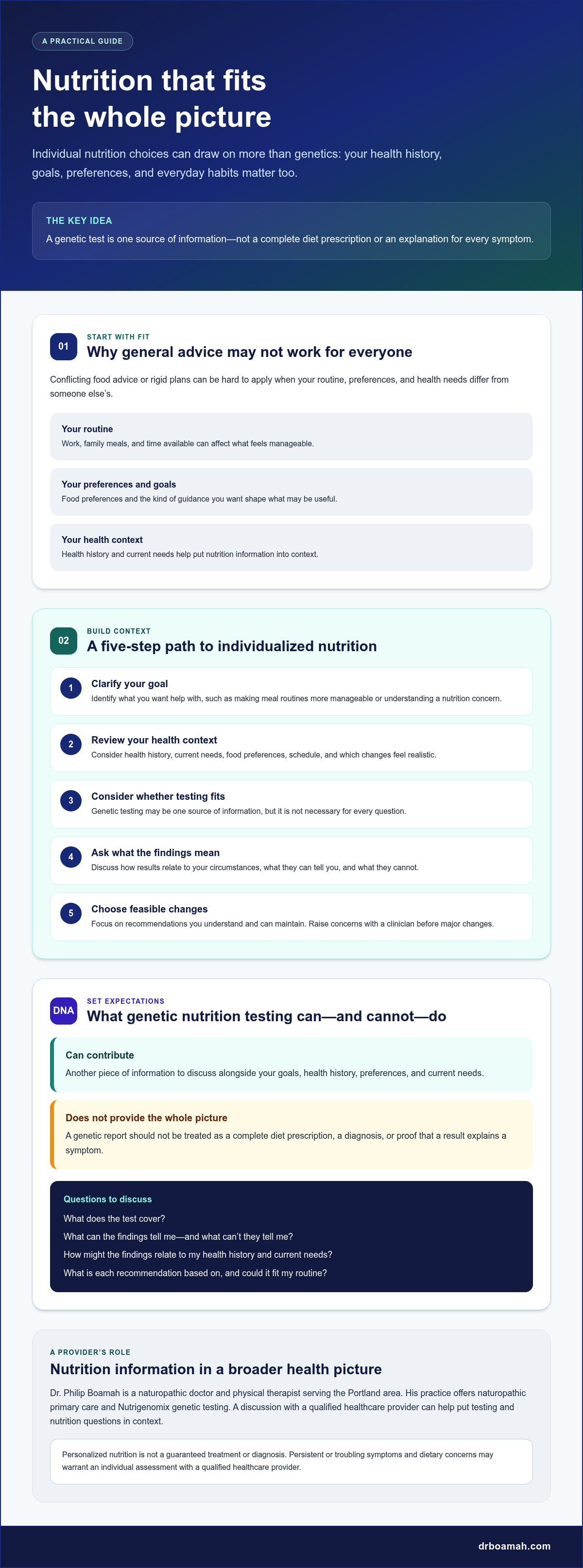
A useful plan begins with your real-life needs, not a test result. Harvard's The Nutrition Source describes precision nutrition as an approach that considers individual differences alongside broader nutrition guidance. That distinction helps set expectations: personalized advice should add context, not promise a diagnosis or a guaranteed outcome.
Use this sequence to make the process practical:
- Clarify your goal. Identify what you want guidance with, such as making meal routines more manageable or understanding a nutrition concern.
- Review your health context. Consider your health history, current needs, food preferences, schedule, and which changes feel realistic.
- Consider whether testing fits. Genetic testing may be one source of information, but it isn’t necessary for every question.
- Ask what the findings mean. Discuss how any results relate to your circumstances, what they can tell you, and what they can’t.
- Choose feasible changes. Focus on recommendations you understand and can maintain. Raise concerns with a clinician before making major changes.
What genetic nutrition testing can and cannot contribute
Dr. Boamah’s practice offers Nutrigenomix genetic testing, but a genetic report should not be treated as a complete diet prescription. Ask what the test covers, how to understand its findings, and how those findings might relate to your health history, preferences, and current needs. Don’t assume that a result explains a symptom or tells you exactly what to eat.
Before acting on a recommendation, ask what it’s based on, whether it applies to your situation, and how it could fit your routine. Portland-area readers can explore this guide to whether Nutrigenomix testing is worth it and bring their questions to a qualified healthcare provider.
How Dr. Boamah can support personalized nutrition in Portland
When general advice leaves you unsure what applies to you, a conversation about your nutrition goals can help you consider possible next steps. Dr. Philip Boamah, a naturopathic doctor and physical therapist serving Portland and Hillsboro, offers naturopathic primary care and Nutrigenomix genetic testing. You can discuss your goals and whether testing may be appropriate, without assuming that a test is needed or will provide a particular answer.
Nutrition information is most useful when considered as part of your broader health picture. Precision nutrition emphasizes individual differences. A clinical discussion can help you consider test information alongside your health history, current routines, preferences, and concerns.
What to discuss with a naturopathic doctor
Before an appointment, jot down what you’d like help understanding and what you’ve already tried. Useful topics may include:
- Nutrition concerns or symptoms you want to discuss.
- Relevant health history and current routines, including your usual meals and schedule.
- Questions about Nutrigenomix testing, what it may contribute, and how findings would be interpreted in your circumstances.
- Changes you feel ready to consider, as well as practical barriers that could make a plan hard to sustain.
You don’t need to arrive with a complete food diary or a fixed plan. A few clear questions can help guide a conversation about next steps and keep recommendations grounded in your needs. For a preview of the visit, read what to expect from a naturopathic doctor.
If you’re in the Portland area and would like to discuss your nutrition goals with Dr. Boamah, call 541-390-1677 to book an appointment.
Take a practical next step toward nutrition that fits
Food choices can feel less overwhelming when guidance reflects your health concerns, history, goals, and everyday routine. Personalized nutrition isn’t a one-size-fits-all diet or a promise that genetic testing will explain every concern. Genetic information is one possible input, best considered alongside your broader health picture.
For Portland-area patients, Dr. Philip Boamah offers naturopathic primary care and Nutrigenomix genetic testing. You can discuss your nutrition goals, ask what testing may contribute, and consider practical next steps that suit your circumstances.
Ready to talk through your questions? Call 541-390-1677 to schedule an appointment with Dr. Boamah. Use the conversation to identify what you want help with and whether testing or another next step is relevant to your goals.
Frequently Asked Questions
What is personalized nutrition?
Personalized nutrition is food guidance shaped around an individual’s goals, health history, preferences, and daily habits, with testing information considered when relevant. Unlike broad advice for a general population, it takes your circumstances into account. It isn’t a guaranteed treatment or diagnosis, and ongoing symptoms or nutrition concerns may benefit from individual clinical assessment.
Can a DNA test tell me exactly what I should eat?
No. A DNA test may offer one source of information, but it can’t determine an exact menu or, by itself, explain why a symptom occurs. Findings should be considered alongside your health history, current needs, food preferences, and routine. Ask what a test can and can’t tell you, and discuss recommendations with a qualified healthcare provider before making major changes.
Is personalized nutrition the same as a genetic testing diet?
No. A genetic-testing diet generally refers to food recommendations based mainly on DNA information. Personalized nutrition is broader: it can also account for health history, goals, preferences, and everyday routines. Genetic testing may be one input, not a complete diet prescription. A clinician can help put results in context and consider whether they’re relevant to your individual needs.
How can I explore personalized nutrition with a provider in Portland?
Portland-area residents can discuss nutrition goals with Dr. Philip Boamah, who offers naturopathic primary care and Nutrigenomix genetic testing. Bring questions about your health history, current routines, and whether testing may be appropriate. Results should be considered in the context of your broader health picture. To book an appointment, call 541-390-1677.


