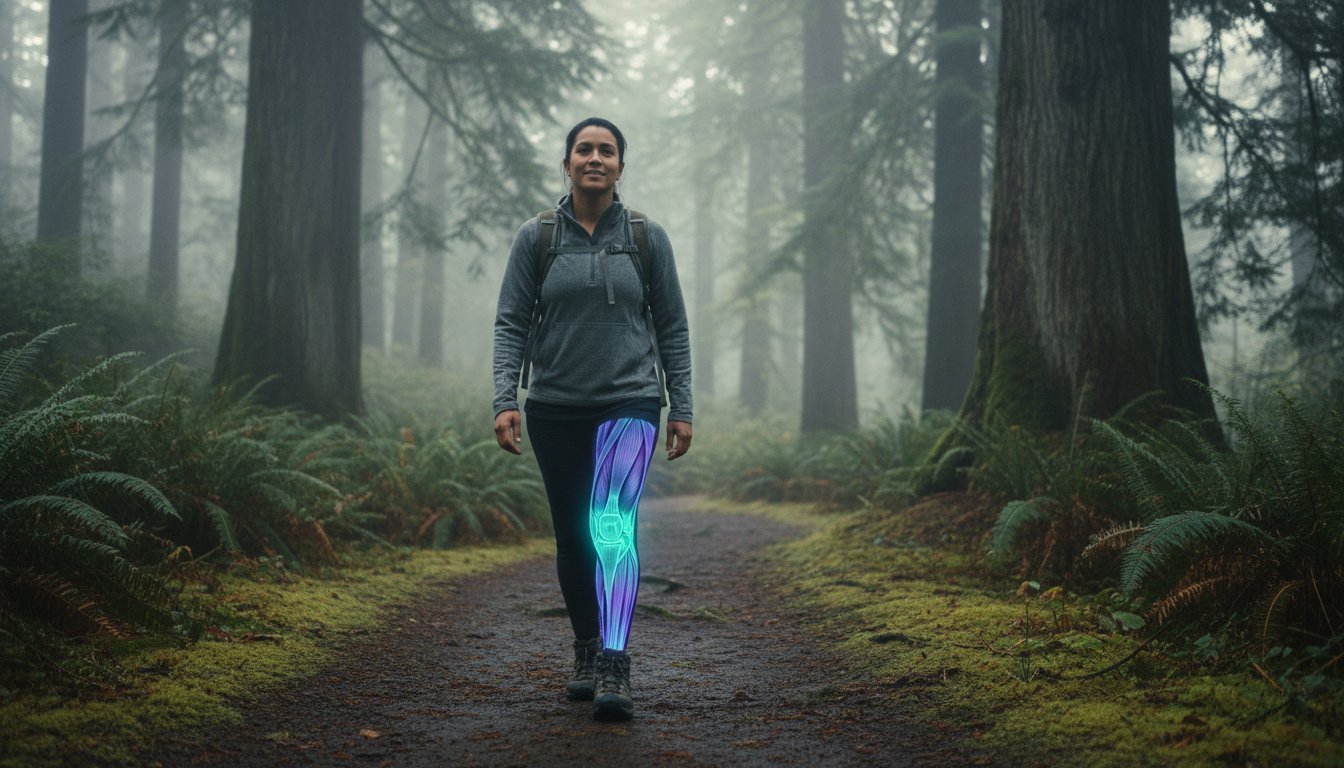
You've spent weeks looking forward to the vibrant spring blooms along the Wildwood Trail, only to have your hike cut short by a sharp, nagging sensation on the outside of your leg. It's incredibly frustrating when your body doesn't keep pace with your spirit, especially when common advice like "just rest it" fails to get you back to the Forest Park trails you love. This guide will help you identify why you're experiencing pain exterior knee and how a tailored, integrative approach can resolve it without surgery. We'll explore the common culprits behind lateral discomfort and the modern recovery checklist used by Portland residents to reclaim their active Oregon lifestyle.
Dr. Philip Boamah bridges the gap between traditional natural medicine and cutting-edge diagnostics like PEMF therapy to treat the root cause of your pain. With the average cost of a physical therapy evaluation in Portland reaching $165 as of May 2026, he focuses on efficient, personalized care that respects your time and your goals. He helps you move past the fear of permanent injury and back into the abundance of our local landscape. Ready to stop guessing and start healing? Call 9713976120 to book your session and begin your journey toward a pain-free life.
Key Takeaways
- Understand how Portland’s unique topography, from Forest Park to the West Hills, contributes to specific lateral knee strain.
- Learn to distinguish between common culprits like IT Band Syndrome and LCL sprains to identify the source of your pain exterior knee.
- Discover why standard "rest and ice" advice often falls short for chronic imbalances and how a biomechanical assessment offers a more sustainable path.
- Explore the Boamah Method’s integrative approach, which combines naturopathic principles with Class 4 Laser Therapy to accelerate tissue regeneration.
- Follow a clear, step-by-step roadmap designed to restore your mobility and get you back to the active Oregon lifestyle you love.
The Problem: Why active Portlanders struggle with pain on the exterior of the knee
Living in Portland means our bodies are often in constant motion. Whether you're navigating the winding roots of Forest Park or the steep, punishing inclines of the West Hills, your joints are doing heavy lifting. When you feel pain exterior knee, it's usually a sign that your lateral stabilizers are struggling to manage the load. This lateral knee pain is discomfort localized specifically to the outer side of the joint. It involves the complex network of ligaments and tendons that keep your knee from buckling during side-to-side movements or steep downhill treks.
Portland's unique topography is a playground, but it's also a biomechanical challenge. The repetitive impact of trail running and the high-torque demands of cycling create a specific type of wear. For many Oregonians, this isn't just a physical ailment; it's an emotional burden. Losing the ability to summit a peak or join a Saturday group ride can feel like losing a piece of your identity. It's frustrating to feel like your adventurous spirit is being held captive by a joint that won't cooperate.
Common symptoms Portland residents report
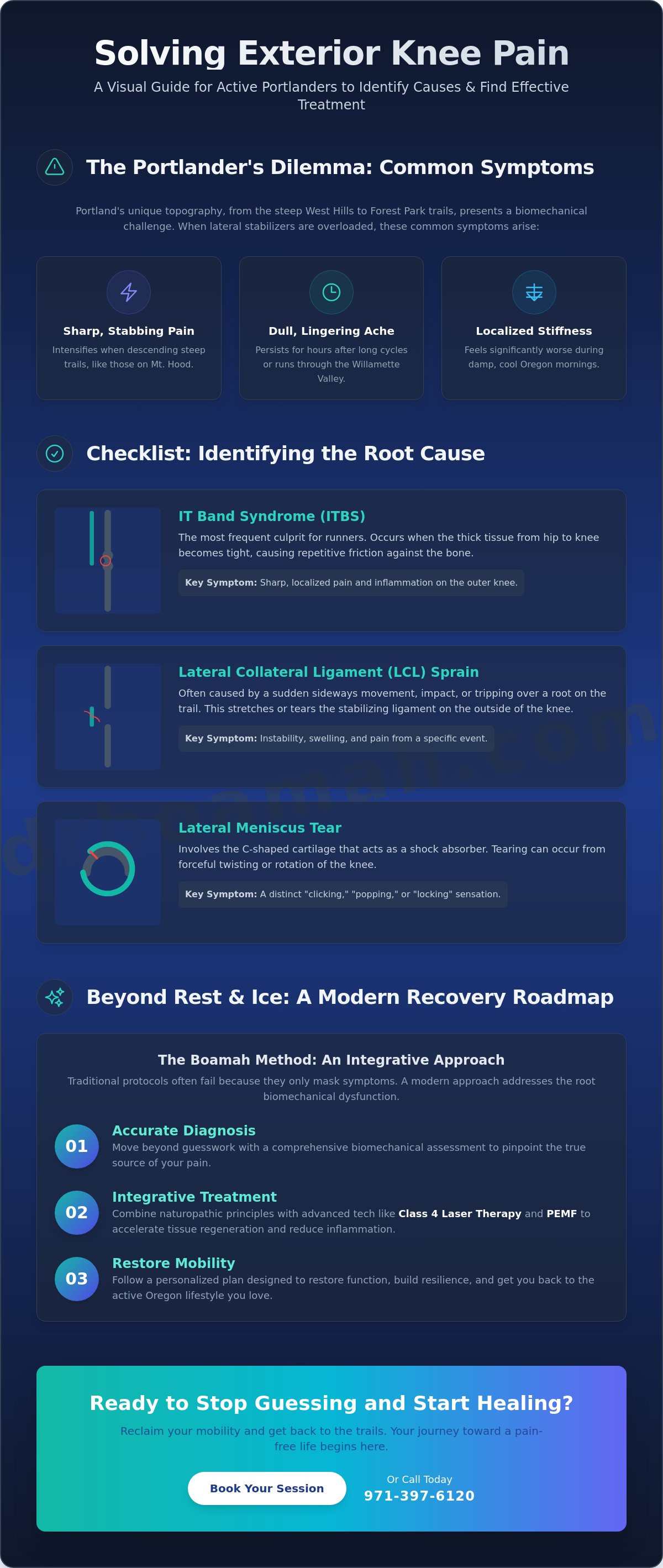
- Sharp, stabbing sensations that intensify specifically when you're descending steep trails like those on Mt. Hood.
- A persistent, dull aching that lingers for hours after long cycles through the Willamette Valley.
- Localized stiffness that feels significantly worse during our signature damp, cool Oregon mornings.
The 'Active Lifestyle' trap
Many of us fall into a common trap. We ignore a small twinge because we don't want to miss a weekend trip. This often leads to Iliotibial Band Syndrome, where the thick tissue running from your hip to your knee becomes chronically inflamed. If you try to "push through" the discomfort, your body begins to compensate. You might start walking differently, which eventually creates secondary issues in your hips and ankles. In the Pacific Northwest, our knees are the primary shock absorbers for our adventurous spirits, making exterior joint health a prerequisite for local life.
Traditional "rest and ice" protocols rarely solve these structural imbalances. Addressing pain exterior knee requires a deeper look at your movement patterns. Dr. Philip Boamah uses a "Tradition-Tech Bridge" to move beyond surface-level symptoms. By combining time-tested natural medicine with advanced diagnostic assessments, he identifies the root cause of your dysfunction. This approach ensures you aren't just masking pain but actually restoring your potential to thrive. If you're ready to reclaim your mobility and get back to the trails, call 9713976120 to book your session today.
Checklist: Identifying the root cause of your lateral knee discomfort
Pinpointing the exact cause of your discomfort is the first step toward reclaiming your Saturday morning routine. While general soreness is common, persistent pain exterior knee often signals a specific structural issue that requires a targeted strategy. Understanding these root causes helps you move away from the frustration of generic treatments and toward a solution that actually works.
- IT Band Syndrome (ITBS): This is the most frequent culprit for runners on the Tualatin Hills trails. It occurs when the thick tissue running from your hip to your knee becomes tight and rubs against the bone. According to Cedars-Sinai on ITBS, this repetitive friction leads to localized inflammation and sharp pain.
- Lateral Collateral Ligament (LCL) Sprains: These are often caused by sudden lateral movements or impact. If you've tripped over a root in the Gorge or made a quick pivot on the soccer field, you may have stretched or torn this stabilizing ligament.
- Lateral Meniscus Tears: This involves the C-shaped cartilage that acts as a shock absorber. You might notice a distinct "clicking" or "locking" sensation when you rotate your leg.
- Lateral Knee Osteoarthritis: For many older adults in the Pacific Northwest, years of hiking and activity can lead to wear and tear. This manifests as a deep, persistent ache on the outer side of the joint.
The IT Band vs. Ligament distinction
Distinguishing between these conditions is vital for your recovery. ITBS typically feels like a "rubbing" or "burning" sensation that intensifies mid-activity. LCL issues often feel like "instability," as if your knee might give out under pressure. Your gluteus medius plays a silent but starring role here; when this hip muscle is weak, it fails to stabilize the thigh, forcing the exterior knee to take the brunt of the force. You'll notice triggers vary: ITBS often flares on flat ground or stairs, while ligament pain is most acute on the rocky, uneven terrain common in our local parks.
When the pain isn't actually in the knee
Sometimes the problem originates elsewhere. Nerves in your lumbar spine or imbalances in your hip joint can send "referred pain" down the leg, mimicking a knee injury. Even your choice of "Portland-style" footwear, such as heavy waterproof boots or worn-out trail runners, can alter your gait and contribute to pain exterior knee. This complexity is why a professional biomechanical assessment in Hillsboro is so effective.
Dr. Philip Boamah specializes in untangling these connections. He doesn't just treat the spot that hurts; he evaluates your entire movement profile to find the true source of your dysfunction. By identifying whether your issue is rooted in local tissue damage or a systemic alignment problem, he creates a personalized path to wellness. If you're ready for a clear diagnosis and a return to the trails, call 9713976120 to book your session today.
Why traditional 'Rest and Ice' protocols often fail Oregonians
If you've been managing pain exterior knee with a bag of frozen peas and a week on the couch, you aren't alone. It's the standard advice given in many clinics. However, for active Oregonians, this approach often feels like a temporary Band-Aid rather than a true cure. The common misconception is that rest alone can heal structural imbalances. While rest might reduce immediate irritation, it doesn't address the underlying biomechanical dysfunction that caused the flare-up. Once you return to the trails, the same faulty movement patterns trigger the same pain, leading to a cycle of frustration that stops you from enjoying our local landscape.
Ice can actually be counterproductive in chronic cases. While it's effective for acute swelling, long-term icing constricts blood flow. This slows down the delivery of essential nutrients required for tissue regeneration. For a runner or hiker dealing with persistent discomfort, we want to encourage cellular repair, not stall it. This is why many people find that their progress plateaus after the first few weeks of traditional care. Many patients spend between $560 and $3,850 on out-of-pocket physical therapy sessions only to have their symptoms return because the root driver wasn't addressed.
The limitations of the conventional medical model
The conventional model often focuses on the symptom rather than the driver. There's a significant danger in over-relying on NSAIDs to mask pain exterior knee. For Portland athletes, this can lead to further injury by ignoring the body's warning signals. Dr. Boamah’s dual licensure as a Naturopathic Doctor and Physical Therapist changes the recovery trajectory by integrating different modalities. He combines traditional natural medicine with advanced diagnostic technology to ensure the science is present while your lifestyle goals remain the focal point.
Systemic factors in knee recovery
One of the biggest missing links in knee recovery is the systemic environment. Your ligaments and tendons don't exist in a vacuum. If you have chronic inflammation in the gut, perhaps from SIBO or Leaky Gut, your body's ability to repair joint tissue is compromised. Similarly, hormone balance plays a vital role in maintaining ligament elasticity. According to Cleveland Clinic's guide to ITBS, while mechanical factors are key, your overall health state dictates how well you respond to treatment. This is where personalized data from Nutrigenomix becomes a game-changer. By understanding your genetic predispositions for inflammation and nutrient absorption, we can tailor your recovery at a cellular level.
Dr. Philip Boamah positions himself as your dedicated healthcare partner to resolve these complex issues. He takes the time to understand the unique genetic and lifestyle factors that impact your wellness. If you're ready to move beyond 'rest and ice' and find a lasting solution that honors your body's potential, call 9713976120 to book your session today.
Your Recovery Roadmap: A checklist for managing exterior knee pain
Reclaiming your potential requires a strategy that moves beyond symptom management. To resolve pain exterior knee, you need a prioritized plan that addresses both local tissue damage and the systemic factors holding you back. This roadmap is designed to transition you from acute discomfort to the abundance of an active Oregon lifestyle within a predictable timeframe.
- Step 1: Immediate Activity Modification: This doesn't mean total rest. It means changing how you move. If steep descents on Mt. Hood trigger pain, focus on flat-ground mobility and low-impact movement until the initial inflammation subsides.
- Step 2: Biomechanical Assessment: We evaluate the 'Portland Kinetic Chain.' This involves analyzing your movement from the foot to the hip to identify where the lateral stabilizers are failing.
- Step 3: Advanced Healing Modalities: We utilize Class 4 Laser and PEMF therapy to stimulate cellular repair. These technologies bridge the gap between traditional care and modern medical innovation.
- Step 4: Nutritional Support: We provide tailored guidance on collagen and connective tissue support. This ensures your body has the raw materials required for ligament and tendon repair.
- Step 5: Progressive Loading: We create a specific return-to-trail protocol. We gradually increase the demand on your joints to ensure they're resilient enough for the uneven terrain of the Columbia River Gorge.
Self-care steps you can take today
Start by checking your trail running shoes for lateral wear patterns. If the outside edge of the sole is significantly thinner, your gait is likely contributing to your pain exterior knee. You can also incorporate simple glute activation drills, such as side-lying clamshells, to help offload the IT band. Additionally, adopt a 'Portland Warm-up' before you head out. In our damp, cool climate, spending 10 minutes increasing blood flow to the joint is a prerequisite for safe activity.
Professional intervention milestones
A successful recovery roadmap for lateral knee pain must transition from symptom suppression to functional restoration within 4-6 weeks. If your self-care efforts don't yield results within 14 days, it's time for professional intervention. According to MDsave data from May 2026, a physical therapy evaluation in Portland costs $165. This initial investment allows us to implement PEMF therapy to accelerate cellular repair in the lateral compartment. Dr. Philip Boamah acts as your supportive guide, ensuring your clinical method aligns with your personal health goals. To start your tailored journey, schedule a comprehensive biomechanical assessment today. If you're ready to unlock your potential and return to the trails, call 9713976120 to book your session.
The Boamah Method: Integrative knee solutions in Portland, Oregon
When conventional treatments leave you feeling stuck, a more comprehensive approach is required to fully resolve pain exterior knee. Dr. Philip Boamah provides a unique synthesis of healthcare by combining Naturopathic Primary Care with expert Physical Therapy. This dual perspective allows him to look beyond the joint itself. He examines the systemic health, genetic predispositions, and biomechanical habits that influence your recovery. This isn't just about managing a symptom; it's about optimizing your entire physical profile so you can thrive in the Pacific Northwest landscape.
At the core of the Boamah Method is the strategic use of advanced healing technologies that are often absent in standard clinics. Class 4 Laser Therapy plays a pivotal role in reducing exterior knee inflammation without the need for pharmaceutical intervention. This high-power laser penetrates deep into the lateral compartment, stimulating tissue repair and providing rapid relief for chronic irritation. By pairing this with PEMF therapy, we can "recharge" damaged knee cells at a mitochondrial level. This technology uses pulsed electromagnetic fields to enhance cellular metabolism, which accelerates the natural healing process and restores resilience to the joint.
Technology meets tradition in Hillsboro
Our Hillsboro clinic functions as a bridge between time-tested natural medicine and modern diagnostic innovation. While many physical therapy offices focus solely on exercise, Dr. Boamah understands both the "why" and the "how" of healing. He utilizes Nutrigenomix to provide personalized nutrition plans based on your unique genetic profile. If your DNA suggests a higher predisposition for inflammation or slower collagen synthesis, your treatment plan is adjusted accordingly. This level of precision ensures that your recovery is as unique as your genetic code, providing a foundation for long-term health that generic protocols simply cannot match.
Schedule your appointment and get back to the trails
Regaining your mobility starts with a single step toward professional, integrative care. Don't let pain exterior knee dictate your boundaries any longer. Take action today to unlock your potential and return to the active Oregon lifestyle you love. To schedule your comprehensive evaluation and begin your personalized recovery journey, call 9713976120 to book your session.
Reclaim Your Mobility and Return to the Trails
Persistent discomfort on the outside of the joint shouldn't keep you from the abundance of the Pacific Northwest. We've explored how identifying the root cause and moving beyond the limitations of "rest and ice" are essential steps for long-term health. Whether you're dealing with IT band friction or structural instability, a comprehensive biomechanical assessment provides the clarity needed to move forward without the fear of surgery or chronic re-injury.
Dr. Philip Boamah provides the expert guidance needed to navigate this journey toward optimal wellness. As a dual-licensed Naturopathic Doctor and Physical Therapist serving the Portland and Hillsboro community since 2018, he combines natural medicine with advanced Class 4 Laser and PEMF therapy. This integrative approach ensures your recovery from pain exterior knee is both scientifically precise and deeply personalized to your unique genetic profile. You don't have to settle for merely managing symptoms when you can unlock your full potential and thrive.
Ready to resolve your knee pain and get back to the Oregon lifestyle you love? Schedule your integrative physical therapy session with Dr. Boamah by calling 9713976120 to book your session today. Your path to a pain-free life is within reach.
Frequently Asked Questions
Is pain on the exterior of the knee always IT band syndrome?
No, while IT band friction is a frequent culprit, it isn't the only source of discomfort. Lateral collateral ligament (LCL) sprains or meniscus tears can also cause pain exterior knee. A detailed biomechanical assessment is necessary to distinguish between these conditions. Dr. Boamah evaluates your entire kinetic chain to ensure we are addressing the root driver of your pain rather than just managing a surface-level symptom.
Can my hiking boots be causing my outer knee pain?
Yes, your choice of footwear can directly impact the stability of your outer knee. Worn-out boots with lateral wear patterns often force the joint into a compromised position during steep trail descents. This creates repetitive strain on the lateral stabilizers. Checking your gear for uneven soles is a vital part of our recovery checklist. We help you choose footwear that supports your unique gait and active Oregon lifestyle.
How does laser therapy help with chronic knee pain?
Class 4 Laser therapy utilizes specific light wavelengths to penetrate deep into the joint and stimulate cellular repair. This process increases ATP production, which provides the energy your cells need to heal damaged ligaments and tendons. It is a non-invasive way to reduce inflammation in the lateral compartment. By combining this technology with traditional natural medicine, we help you return to the trails faster than conventional rest protocols allow.
What happens if I ignore the pain on the outside of my knee?
Ignoring persistent discomfort often leads to compensatory issues in your hips and ankles. When you favor one leg, your body shifts the load to other joints, which can create a cascade of new injuries. Chronic inflammation can also cause permanent changes to the cartilage over time. Addressing pain exterior knee early prevents these complications and ensures you can continue enjoying the abundance of our local landscape without long-term limitations.
Do I need an MRI for lateral knee pain before seeing Dr. Boamah?
No, an MRI is usually not required before your first visit with Dr. Boamah. He performs a meticulous physical and functional assessment that often provides the clarity needed to start your recovery. If imaging is ultimately necessary to confirm a complex diagnosis, he will guide you through that process. Starting with a clinical evaluation allows us to begin restorative treatments immediately rather than waiting for external appointments.
How many sessions of PEMF or Laser therapy are typically needed for knee relief?
Most patients see significant functional improvements within 6 to 12 sessions of PEMF or Laser therapy. The exact number depends on whether your issue is acute or a chronic imbalance that has persisted for months. Every treatment plan is tailored to your specific goals and genetic profile. We focus on achieving functional restoration within a predictable 4 to 6 week window so you can return to your favorite activities.
Can hormone imbalances really affect my knee health?
Yes, your internal chemistry significantly affects the resilience of your joints. Hormone levels influence collagen production and the elasticity of your ligaments. If these systemic factors are out of balance, your body may struggle to repair the micro-tears that occur during strenuous hiking. Dr. Boamah uses his dual expertise to address these internal drivers, ensuring your recovery is rooted in total body wellness rather than just joint mechanics.
How do I book an appointment for knee pain in Portland?
You can schedule your integrative physical therapy session by calling our local office directly. Dr. Boamah is dedicated to serving the Portland and Hillsboro community as a trusted healthcare partner. We take the time to understand your unique lifestyle and genetic factors to create a path toward optimal health. To stop managing symptoms and start thriving in the Pacific Northwest, call 9713976120 to book your session today.


