
What if the standard advice to "just rest" is actually delaying your return to the Pacific Northwest trails? For the 1 in 4 adults over age 50 who sustain a tear, the fear of losing access to Forest Park or the Columbia River Gorge is a heavy burden. You likely want a clear path to recovery but feel skeptical that passive rest or invasive surgery are your only options. Finding effective meniscal injuries treatment in Portland shouldn't mean choosing between a scalpel and the sidelines.
Dr. Philip Boamah offers a sophisticated, non-surgical solution that honors your active Oregon lifestyle. By bridging the gap between structural physical therapy and advanced Class IV laser technology, his integrative approach stimulates tissue repair at the cellular level. You'll learn how this tailored strategy restores pain-free movement and helps you avoid the operating table. This article explores how modern diagnostics and regenerative tools work together to get you back to peak performance.
You don't have to navigate this recovery alone or settle for a life of limited mobility. To start your journey toward optimal health with a trusted local expert, call 9713976120 to book your session with Dr. Boamah today.
Key Takeaways
- Understand why common treatments like cortisone shots may actually hinder long-term recovery for your knee's shock-absorbing cartilage.
- Discover how Dr. Boamah uses Class 4 Laser technology to stimulate ATP production and accelerate natural healing at the cellular level.
- Learn how a personalized meniscal injuries treatment plan integrates manual therapy and targeted nutrition to restore stability and strength.
- Identify the specific corrective exercises designed to offload pressure from the meniscus, allowing for a safer return to your active lifestyle.
- Take control of your mobility today by calling 9713976120 to schedule your personalized assessment with Dr. Boamah.
The Challenge of Meniscal Injuries for Active Portlanders
Living in Portland means your knees take a beating, whether you're navigating the roots on the Wildwood Trail or cycling across the Tilikum Crossing. A meniscus tear is more than a simple structural rip; it's a fundamental disruption of your knee's internal shock absorption system. When this C-shaped cushion fails, the smooth mechanics of your joint are replaced by clicking, locking, and a disconcerting "giving way" sensation on uneven terrain. For the 14% of patients who experience these mechanical symptoms, the injury feels like a betrayal of their active lifestyle.
Seeking effective meniscal injuries treatment in Portland becomes urgent when you realize that "pushing through" only deepens the damage. The meniscus is notoriously difficult to heal because of its unique blood supply. The outer "Red Zone" has access to nutrient-rich blood and can often repair itself with the right support. However, the inner two-thirds, known as the "White Zone," lacks direct circulation. This biological hurdle is why many people find themselves stuck in a cycle of chronic pain and limited mobility, wondering if surgery is their only path forward.
To better understand the biological potential for healing without a scalpel, watch this helpful video:
Why Meniscal Pain Hits Differently in the PNW
Portland’s unique geography and climate add layers of complexity to your recovery. Hiking the 2,800-foot elevation gain of Dog Mountain or cycling the Waterfront requires precise joint stability that a damaged meniscus cannot provide. Our damp, cool Oregon winters often exacerbate joint stiffness and swelling, making the "wait and see" approach particularly frustrating. While you wait for the pain to subside, your activity levels drop and your connection to the local landscape suffers. This decline isn't just physical; it's an emotional loss for those who define their wellness through outdoor movement.
The Limits of Traditional 'Rest and Ice' Protocols
For decades, the RICE protocol was the gold standard, but modern clinical insights suggest that prolonged rest can be counterproductive for meniscal injuries treatment. While ice might manage acute swelling, it doesn't address the underlying need for cartilage regeneration or structural realignment. In fact, research shows that excessive inactivity leads to measurable muscle atrophy in the quadriceps and glutes within just 14 days of reduced loading. This weakness creates secondary pain in the hips and ankles as your body tries to compensate. True healing requires a transition from passive "resting" to active, controlled movement that signals the body to repair itself.
Why Standard Meniscal Treatments Often Fall Short
Traditional orthopedics often defaults to a "mechanical" view of the knee. This results in an over-reliance on cortisone injections. While these shots provide temporary relief, repeated use can actually degrade the very collagen fibers your knee needs to heal. Many patients are steered toward a meniscus tear diagnosis and treatment plan that leads directly to the operating room, often without exploring how the body's own regenerative potential can be harnessed. This surgical bias prioritizes quick fixes over long-term joint integrity.
Standard physical therapy often focuses solely on strengthening the surrounding muscles. This is vital, but it frequently misses the cellular component of recovery. Without addressing the metabolic and inflammatory environment of the joint, even the best exercises can't bridge the gap between a "stable" knee and a truly healthy one. Effective meniscal injuries treatment requires more than just a list of leg lifts; it needs a strategy that supports tissue repair from the inside out. Generic programs simply don't account for how your body specifically handles inflammation.
The Hidden Risks of Premature Meniscal Surgery
A partial meniscectomy removes the torn piece of cartilage, which might stop the clicking but also reduces the knee's total surface area for weight distribution. Studies indicate that removing just 15% to 34% of the meniscus can increase joint contact pressure by up to 350%. This structural change often accelerates early-onset osteoarthritis. While surgery has a recovery timeline of 4 to 6 months, advanced conservative care aims to preserve your natural anatomy for the long term. Preserving your native tissue is the best way to ensure you're still hiking in ten years.
Missing the Holistic Connection: Nutrition and Genetics
Your knee doesn't exist in a vacuum. Systemic inflammation, often driven by diet or stress, can stall the progress of your meniscal injuries treatment. We use tools like Nutrigenomix to identify specific genetic markers that influence how your body processes collagen and micronutrients. A one-size-fits-all approach fails because it ignores your unique biological blueprint. By tailoring your recovery to your DNA, we unlock a level of healing that standard protocols simply cannot reach. If you're tired of temporary fixes, you might consider how personalized clinical care can change your outcome.
Dr. Boamah understands that your recovery should be as unique as your genetic code. By bridging clinical authority with neighborly warmth, he helps you navigate away from invasive procedures toward a path of lasting wellness. To start your journey toward a pain-free life, call 9713976120 to book your session today.
Dr. Boamah’s Solution: Advanced Non-Invasive Modalities
Dr. Philip Boamah stands as a unique figure in the Portland healthcare community. As a dual-licensed specialist bridging the gap between Naturopathic medicine and Physical Therapy, he views the knee as a complex biological system rather than just a mechanical hinge. This integrated perspective is essential for effective meniscal injuries treatment, as it allows for a recovery plan that addresses both structural alignment and cellular vitality. By merging clinical authority with neighborly warmth, Dr. Boamah creates a partnership with his patients that is rooted in trust and results.
The core of his success lies in what we call the "Tradition-Tech Bridge." This philosophy honors the body's innate ability to heal while utilizing the most sophisticated technology available in modern medicine. For active Oregonians, this means access to therapies that were once reserved for elite professional athletes. Instead of removing precious joint tissue through surgery, Dr. Boamah uses precise, non-invasive tools to signal the body to repair itself. These technologies don't just mask the pain; they provide the biological fuel necessary for long-term joint health.
Class 4 Laser: Accelerating the Healing Cascade
Class 4 Laser Therapy is a high-power therapeutic tool that penetrates deep into the knee joint to reach the specific site of the meniscal tear. While many clinics use "Cold Lasers" (Class 3), these often lack the power levels required to reach the deep-seated tissues of the knee. The Class 4 laser delivers a higher dosage of therapeutic energy, triggering a process called photobiomodulation. This process stimulates the production of ATP, the primary energy source for cellular repair, which is vital for healing the poorly vascularized "white zone" of the meniscus. During the treatment, you'll feel a pleasant, warm sensation as the laser works to reduce inflammation and increase local circulation. Most patients observe a 50% to 70% reduction in swelling within the first four sessions.
PEMF Therapy: Recharging Your Cellular Health
Pulsed Electromagnetic Field (PEMF) therapy acts as a wireless charger for your damaged cells. When you sustain a meniscus injury, the surrounding bone and soft tissue often develop deep joint edema that standard ice and rest cannot reach. PEMF sends low-frequency electromagnetic pulses through the knee, which helps restore the electrical potential of the cell membranes. This "recharging" effect facilitates faster nutrient exchange and waste removal at the cellular level. It's particularly effective for those experiencing chronic "bone-on-bone" sensations or long-standing stiffness. The treatment is entirely non-invasive with no needles and no downtime. You can walk out of the clinic and head straight for a light stroll in the West Hills, feeling more stable and empowered in your movement.
Dr. Boamah is dedicated to helping you unlock your potential and return to the trails you love. To experience this advanced approach to meniscal injuries treatment, call 9713976120 to book your session today.
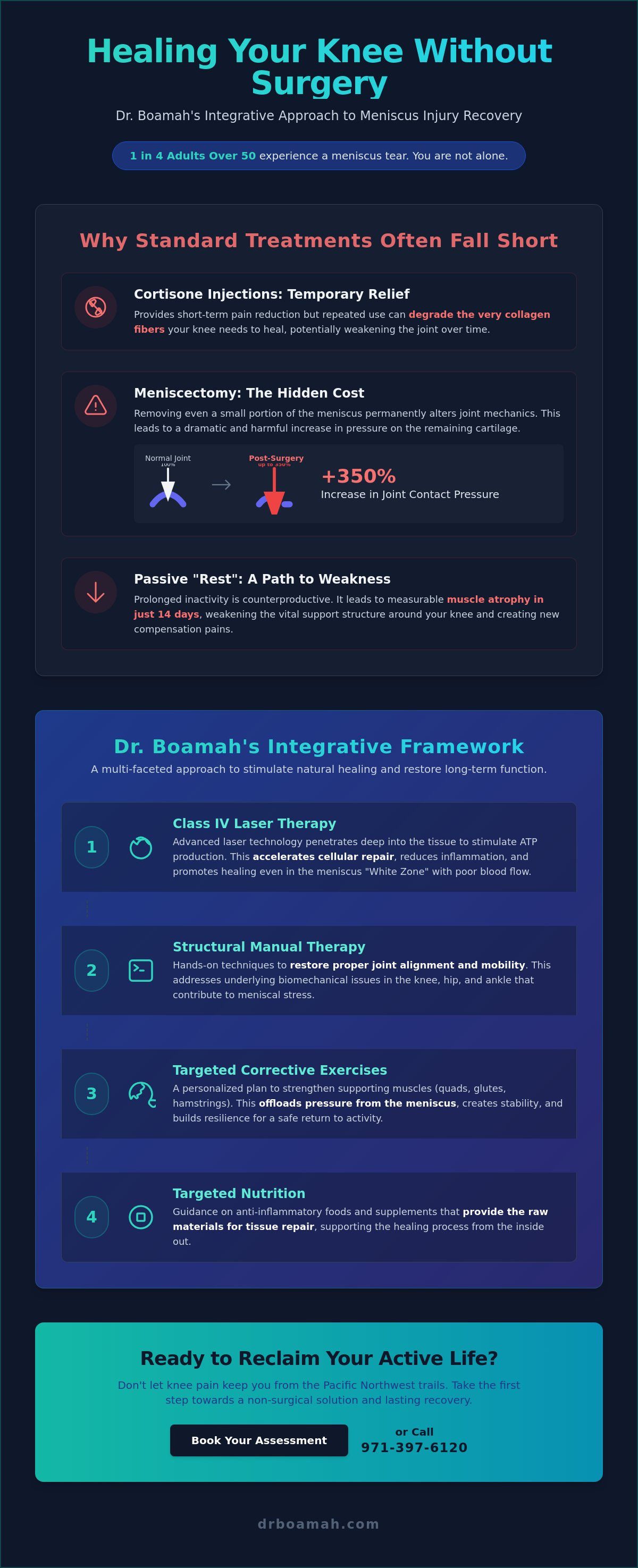
An Integrative Framework for Meniscal Recovery
Recovery often plateaus when patients receive fragmented care. You might get a list of exercises from one clinic and a generic supplement recommendation from another, but these pieces rarely fit together. Dr. Boamah’s integrative framework for meniscal injuries treatment solves this by uniting Manual Therapy, Advanced Modalities, and Targeted Nutrition into a single, cohesive roadmap. This 3-pillar approach ensures that we aren't just treating a knee; we're optimizing the entire human being for the demands of an active Oregonian lifestyle.
By acting as your Naturopathic Primary Care provider, Dr. Boamah manages the systemic environment that dictates how well you heal. Whether you're planning a summer summit of Mt. Hood or just want to walk the dog through Forest Park without a brace, your goals define the pace of our treatment. We don't believe in "one size fits all" because your biology and your lifestyle are unique signatures that require a tailored response. This creates an atmosphere of trust and partnership as we move toward your optimal health.
Manual Therapy and Corrective Movement
Hands-on manual therapy is a vital step in restoring the joint space that often collapses after a meniscus injury. By gently mobilizing the knee, we improve the flow of synovial fluid. This fluid is the lifeblood of your cartilage, carrying the nutrients necessary for repair. However, a knee injury is rarely just about the knee. We look for "energy leaks" in the hips and ankles that may have caused the meniscus to overload in the first place. For example, a 10-degree loss in ankle mobility can increase the rotational stress on your knee by nearly 20% during a descent. Our corrective loading protocols teach your meniscus to adapt and strengthen, turning a point of weakness back into a resilient shock absorber.
The Role of Personalized Nutrition in Cartilage Repair
Systemic health is the foundation of local tissue repair. Through Nutrigenomix testing, we can see if your body has a genetic predisposition for poor collagen synthesis or heightened inflammatory responses. This data allows us to recommend specific micronutrients that support joint integrity without the digestive side effects of NSAIDs. We call this the Pacific Northwest Advantage; we pair advanced genetic insights with an abundance of local, nutrient-dense foods like wild-caught salmon and antioxidant-rich berries. This tailored fueling strategy ensures your body has the raw materials it needs to rebuild. If you're ready to move beyond generic advice, you can schedule your integrative recovery roadmap to see how these pillars work for you.
Dr. Boamah is here to guide you toward a life of abundance and pain-free movement. To start building your personalized recovery path, call 9713976120 to book your session today.
Schedule Your Meniscal Consultation with Dr. Boamah in Portland
Living with knee pain often feels like a constant calculation of what you can and cannot do. You might skip the Saturday morning run at Tryon Creek or hesitate to join friends for a bike ride along the Willamette. This hesitation is the hidden cost of an unresolved injury. Dr. Boamah believes that meniscal injuries treatment should empower you rather than restrict you. By choosing a non-surgical path, you're not just avoiding a hospital stay; you're actively preserving the natural structural integrity of your joint for decades to come.
Our Portland clinic serves as a hub for those who refuse to let a "tear" define their future. Dr. Boamah’s dual perspective as a Naturopathic Doctor and a Physical Therapist allows him to see the biochemical and biomechanical factors simultaneously. This isn't a high-volume clinic where you're just a chart number. Instead, it's a practice rooted in the Pacific Northwest values of community, nature, and personalized care. We're dedicated to helping you thrive in the landscape we all call home.
What to Expect at Your First Integrative Appointment
Your journey begins with a comprehensive 90 minute evaluation that goes far beyond a simple physical exam. We start with a deep dive into your diagnostic history, reviewing any previous MRIs or X-rays to understand the specific geometry of your injury. From there, we perform a detailed biomechanical assessment to see how your entire kinetic chain, from your glutes to your big toe, impacts your knee health. We look for the "why" behind the pain, not just the "where."
This session is a collaborative partnership. You'll walk away with a clear understanding of your condition and a roadmap tailored to your specific goals. Whether you want to return to competitive cycling or simply walk up your driveway without clicking, we align every modality to that outcome. Our commitment to the Portland community means we understand the functional demands of your life, from navigating wet pavement to weekend adventures in the Cascades.
Take Action: Restore Your Mobility Today
The path to recovery doesn't have to be paved with invasive procedures or endless "rest." By integrating Class 4 Laser, PEMF therapy, and targeted nutrition, we provide your body with the tools it needs to regenerate. For residents in the Portland and Beaverton areas, accessing this level of specialized meniscal injuries treatment is the first step toward reclaiming your active Oregon lifestyle. You've already learned how the "Tradition-Tech Bridge" can transform your healing potential; now it's time to put that knowledge into practice.
Don't wait for your mobility to decline further while you're stuck on a surgical waiting list. To schedule your initial consultation and discover how Dr. Boamah can help you heal without surgery, call 9713976120 to book your session today. Your future self on the trail will thank you.
Reclaim Your Pacific Northwest Lifestyle
A meniscus injury doesn't have to signal the end of your time on the trails. While traditional methods often focus on masking symptoms or removing vital tissue, Dr. Boamah’s approach targets the biological root of the problem. His unique dual licensure as a Naturopathic Doctor and Physical Therapist ensures that every facet of your health is considered. By utilizing on-site Class 4 Laser and PEMF technology alongside personalized Nutrigenomix testing, he provides a scientific foundation for lasting recovery. This integrative framework ensures your meniscal injuries treatment is as precise as your genetic code and as resilient as the Oregon wilderness.
You deserve a recovery plan that matches the intensity of your active lifestyle. Ready to heal your knee and get back to the trails? You can schedule your meniscal injury evaluation and start your journey toward pain-free movement today. Call 9713976120 to book your session and partner with a local expert who is dedicated to your long-term success. Your potential for wellness is waiting to be unlocked.
Frequently Asked Questions
Can a meniscal tear really heal without surgery?
Yes, many meniscal tears can heal or become asymptomatic through non-surgical means. Research published in the British Journal of Sports Medicine shows that for degenerative tears, exercise therapy is often as effective as surgery after a 2-year follow-up. By combining structural physical therapy with regenerative technologies, we support your body's natural repair mechanisms. This approach is particularly effective for the 1 in 4 adults over age 50 who experience these injuries.
How many sessions of Class 4 Laser therapy will I need for a meniscus injury?
Most patients require between 6 and 12 sessions of Class 4 Laser therapy to achieve optimal results. While some experience a 50% reduction in pain within the first 3 visits, the cumulative effect of the laser is necessary to stimulate deep tissue repair. Each session lasts about 10 to 15 minutes. We monitor your progress closely to ensure the treatment plan evolves with your knee's increasing stability and comfort.
Is PEMF therapy safe for everyone with knee pain?
PEMF therapy is safe for nearly everyone, though there are a few specific exceptions. Individuals with implanted electronic devices like pacemakers or those who are currently pregnant should avoid this treatment. For the vast majority of Portlanders, it's a painless way to reduce joint edema and "recharge" cellular health. It's an excellent option for those who want to avoid the risks associated with long-term NSAID use or invasive injections.
What is the difference between a medial and lateral meniscus tear treatment?
Medial tears occur on the inside of the knee and are 3 times more common than lateral tears. Lateral tears involve the outer cushion and often require more focus on rotational stability. Your meniscal injuries treatment plan will differ based on which side is affected. We adjust your corrective exercises to offload the specific area of injury while strengthening the surrounding muscles to provide better shock absorption during your daily activities.
How soon can I return to hiking or running after starting treatment?
Most patients return to light hiking or low-impact movement within 4 to 8 weeks of starting our integrative program. Returning to high-impact running may take 12 weeks or longer depending on the tear's severity and your baseline strength. We use specific functional milestones to ensure your knee can handle the uneven terrain of Forest Park before you head out. This gradual approach prevents re-injury and builds long-term confidence in your joint's resilience.
Does Dr. Boamah accept insurance for physical therapy and naturopathic visits?
Our clinic accepts several major insurance plans for both physical therapy and naturopathic primary care visits. Because coverage varies significantly between providers, we recommend a 5-minute benefit check with our administrative team before your first appointment. This transparency helps you focus entirely on your recovery journey. For services not covered by traditional insurance, we offer clear options to ensure you can access the advanced technology your knee requires.
What happens if I ignore a meniscal injury?
Ignoring a meniscus injury often leads to a 3-fold increase in the risk of developing early-onset osteoarthritis. When the knee loses its shock absorber, the underlying bone begins to take direct impact; this leads to "bone-on-bone" pain over time. Additionally, your body will naturally compensate for the instability, which often causes secondary issues in your hips or lower back. Addressing the injury early through proper meniscal injuries treatment preserves your native tissue and keeps your mobility intact.
You don't have to let a knee injury sideline you from the activities you love. Dr. Boamah is ready to help you find a path to recovery that avoids surgery and restores your strength. To take the first step toward pain-free movement, call 9713976120 to book your session today.


