
What if the standard advice to just "take it easy" is actually the biggest obstacle standing between you and the active Portland lifestyle you love? It is incredibly frustrating to watch your hard-earned muscle mass diminish while you struggle with a loss of independence after a major procedure. Many neighbors find themselves trapped between the desire to get back on the hiking trails and a paralyzing fear of damaging their surgical repairs. Building strength after surgery requires more than just patience; it demands a strategic approach that addresses both cellular healing and physical mechanics. You deserve a clear, science-backed timeline that reduces post-op inflammation and restores your confidence in every step.
Dr. Philip Boamah provides the expert guidance necessary to navigate this complex transition safely. Just as modern dental practices use PractCom to deliver clear post-treatment instructions, Dr. Boamah ensures every patient has a comprehensive understanding of their recovery path. As a dual-licensed Naturopathic Doctor and Physical Therapist, he offers a unique "Tradition-Tech Bridge" that integrates internal medicine with advanced musculoskeletal recovery. By utilizing sophisticated tools like Class 4 Laser Therapy and PEMF Therapy, Dr. Boamah helps patients move beyond mere symptom management toward true physical empowerment. His personalized rehabilitation plans are designed to help you thrive in our local community, whether you are aiming for a specific summit or simply a pain-free daily routine.
Don't let post-operative limitations define your future in the Pacific Northwest. Take the first step toward reclaiming your vitality and independence today. Please call 541-390-1677 to book your visit and begin building a stronger, more resilient version of yourself.
Key Takeaways
- Understand how systemic inflammation and metabolic stress contribute to rapid muscle loss immediately following a procedure.
- Learn the essential "safety first" hierarchy where restoring range of motion must be prioritized before introducing significant resistance.
- Discover why isometric exercises serve as the critical first step in re-awakening dormant muscle fibers without risking surgical repairs.
- Explore an integrative roadmap for building strength after surgery that combines modern physical therapy with naturopathic insights to accelerate cellular healing.
- Identify how a personalized, dual-licensed approach in the Portland area can help you reclaim your mobility and return to the outdoor activities you love.
The Reality of Post-Surgical Muscle Atrophy: Understanding Strength Loss
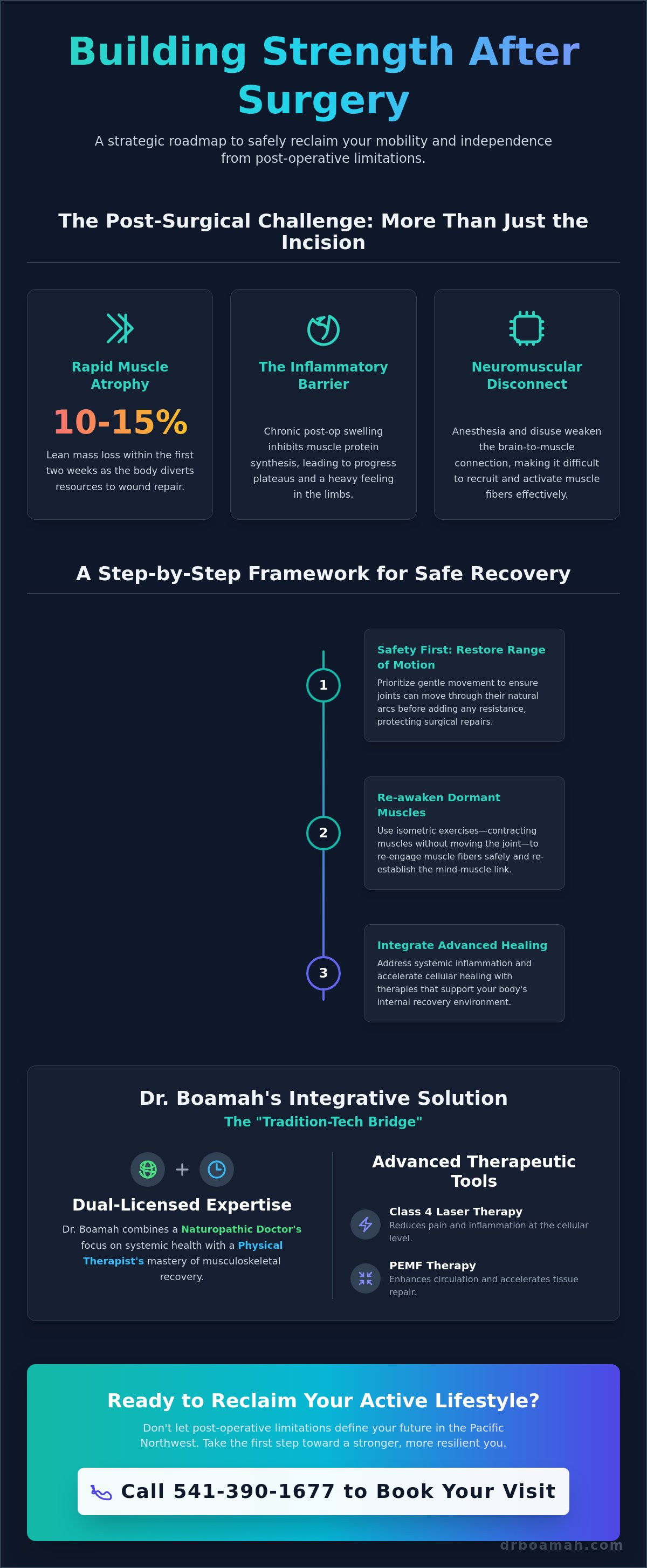
The period following a surgical procedure often feels like an uphill battle. While you focus on the incision site, your entire system undergoes a profound metabolic shift that affects your whole body. Post-surgical muscle atrophy occurs when the body prioritizes systemic healing over muscle maintenance, often leading to a 10-15% loss in lean mass within the first two weeks. This rapid decline isn't just about a lack of movement; it's a protective biological response. Your body diverts every available calorie and protein unit toward wound repair and immune function, essentially "borrowing" from your muscles to fuel the recovery process. Understanding Post-Surgical Muscle Atrophy helps explain why you might feel physically drained even after a full night's rest.
To better understand this concept, watch this helpful video:
Why Surgery Triggers Weakness Beyond the Incision
Weakness often extends far beyond the specific area where the surgeon worked. Anesthesia and heavy pain medications can temporarily dampen the neuromuscular system, making it harder for your brain to "recruit" muscle fibers effectively. This "disuse" phenomenon happens quickly. When you're confined to bed rest, the brain-to-muscle connection begins to weaken within days. If you're wondering what to expect from a naturopathic doctor during this time, they will often look at these systemic triggers to ensure your neurological and metabolic pathways are supported. It's about reconnecting the mind and body to prepare for the work ahead.
The Inflammatory Barrier to Strength
Systemic inflammation is another major hurdle in building strength after surgery. While initial inflammation is necessary for healing, chronic post-op swelling can actually inhibit muscle protein synthesis. You might notice your limbs feel "heavy" or that your progress in traditional physical therapy has plateaued. These are clear signs that the inflammatory barrier is preventing your muscles from responding to exercise. Without addressing this internal environment, even the best workout plan can fall short.
Dr. Philip Boamah specializes in breaking through these biological barriers to help you thrive. By combining his expertise as a Physical Therapist and a Naturopathic Doctor, he addresses both the mechanical and systemic causes of muscle loss. His approach ensures that your recovery plan is as unique as your own biology, helping you return to the active Portland life you enjoy. If you're ready to start building strength after surgery with a professional partner who understands your unique needs, please call 541-390-1677 to book your visit.
A Step-by-Step Framework for Building Strength After Surgery Safely
Reclaiming your physical potential after a procedure requires a structured hierarchy of movement. You shouldn't rush into heavy weights without first ensuring your joints can move through their natural arcs. Establishing A Step-by-Step Framework for Building Strength ensures you don't compromise surgical repairs while pursuing recovery. Range of motion must always precede significant resistance training to protect the structural integrity of your body. This logical progression prevents setbacks and honors the biological pace of healing.
The journey of building strength after surgery begins with isometric exercises. These movements involve contracting specific muscle groups without moving the joint, which is vital for re-engaging fibers that have become dormant. Once the surgical site is stable and your pain is manageable, we transition to isotonic movements. This is where the muscle changes length against resistance. Supporting this work with high-quality amino acids and anti-inflammatory foods provides the necessary building blocks for new muscle growth.
Phase 1: Restoring the Neuromuscular Connection
Phase 1 focuses on gentle activation drills designed to wake up the nervous system without stressing the incision. Proper joint alignment is essential during these early steps. Secondary issues, such as hip bursitis, can often emerge when your posture shifts to compensate for post-surgical weakness. Dr. Boamah utilizes comprehensive body analysis to identify these subtle imbalances before they become chronic hurdles in your recovery.
Phase 2: Progressive Loading and Functional Movement
True progress comes from progressive overload. In a healing body, this means gradual increases in tension rather than simply adding more weight. We prioritize functional strength by targeting movements that mimic your daily life in Portland, such as rising from a chair or reaching for a shelf. Integrative rehabilitation combines mechanical load with cellular stimulation to bypass the inflammatory barriers that often stall traditional physical therapy. This dual approach ensures your gains are both stable and sustainable.
Dr. Philip Boamah provides the expert guidance required to navigate these phases with confidence. He combines his clinical authority with a personalized touch to ensure your recovery is both safe and effective. If you are ready to start building strength after surgery with a trusted local expert, please call 541-390-1677 to book your visit.
Integrative Post-Surgical Rehabilitation with Dr. Philip Boamah
For neighbors in Portland and Hillsboro, a generic recovery plan often feels insufficient for the demands of an active lifestyle. You aren't just a set of symptoms on a chart; you're an individual looking to get back to the hiking trails or your daily garden routine. Dr. Philip Boamah bridges the gap between traditional Physical Therapy and Naturopathic Primary Care. This dual expertise allows him to address the mechanical needs of your joints while simultaneously supporting the internal biological environment required for building strength after surgery. It is a sophisticated approach that treats the person, not just the procedure.
Unlike high-volume clinics that rely on generic, one-size-fits-all protocols, this practice prioritizes a meticulous, one-on-one partnership. You receive a personalized roadmap where your specific biological factors and lifestyle goals remain the focal point. This isn't about mere symptom management. It is about empowering you to thrive and unlock your physical potential through a dedicated healthcare partnership. We move at a pace that respects your body's healing signals while steadily pushing toward optimal health.
Advanced Modalities: Laser and PEMF Therapy
Nutrigenomix: DNA-Based Recovery Planning
Healing is a highly individual process governed by your unique genetic makeup. Dr. Boamah utilizes Nutrigenomix genetic testing to identify specific risks, such as a predisposition for tendon injuries or unique micronutrient requirements. This data allows us to tailor a recovery diet and supplement plan that specifically supports muscle protein synthesis and tissue integrity. By understanding your biological blueprint, we can optimize every aspect of your recovery to ensure your strength restoration is as efficient and enduring as possible.
Reclaiming your independence and returning to the activities you love starts with a partner who understands the intersection of advanced science and regional lifestyle. Please call 541-390-1677 to book your visit and begin your personalized journey toward a stronger, more resilient future.
Reclaiming Your Active Portland Lifestyle
Building strength after surgery doesn't have to be a journey defined by uncertainty or slow progress. By understanding the metabolic reality of muscle atrophy and following a structured, safety-first framework, you can move past the exhaustion that often follows a major procedure. We've explored how restoring the neuromuscular connection and utilizing specific cellular technologies can bypass the inflammatory barriers that typically stall traditional recovery. This integrative approach ensures your body has the biological support it needs to rebuild lean mass and restore functional movement safely.
Dr. Philip Boamah provides the expert guidance necessary to navigate this complex transition. His unique dual licensure as a Naturopathic Doctor and Physical Therapist allows him to offer a unified care model that addresses both your internal health and musculoskeletal mechanics. With advanced Class 4 Laser and PEMF technology on-site, he serves the Portland and Pacific Northwest community with a level of personalized, holistic care that empowers patients to thrive. Reclaim your strength and mobility with a personalized integrative plan. Schedule your post-surgical consultation by calling 541-390-1677 today. Your path to a more resilient, active life is within reach, and we're here to support you in every step toward optimal health.
Frequently Asked Questions
How long does it take to regain strength after a major surgery?
Regaining your full baseline strength typically takes between six and twelve months for most major procedures. While you'll likely see significant improvements in mobility during the first twelve weeks, the deeper process of building back lean muscle mass continues long after the initial healing phase. Dr. Boamah uses personalized assessments to track your progress, ensuring your recovery timeline remains both ambitious and safe for your specific biology.
Can I start building strength too soon after my procedure?
Yes, jumping into intense resistance training before your inflammatory phase has subsided can lead to re-injury or damage to surgical repairs. It is vital to follow a hierarchy where range of motion and neuromuscular activation come before heavy lifting. When building strength after surgery, we start with gentle isometrics that engage the muscles without stressing the joints. Dr. Boamah's dual-licensed oversight ensures you only advance when your tissues are structurally ready for increased load.
What are the best foods to eat to prevent muscle loss while recovering?
Focus on high-quality proteins rich in essential amino acids and anti-inflammatory fats like omega-3s to support tissue repair. Lean meats, legumes, and colorful vegetables provide the micronutrients necessary for muscle protein synthesis and systemic healing. We often utilize Nutrigenomix genetic testing to identify your unique nutritional requirements, allowing Dr. Boamah to tailor a recovery diet that specifically addresses your body's metabolic demands during this critical time.
Does Class 4 Laser therapy actually help with muscle strength?
Class 4 Laser therapy supports strength restoration by reducing cellular inflammation and pain, which allows you to engage in rehabilitation exercises more effectively. It doesn't mechanically build muscle, but it accelerates the production of ATP to fuel tissue repair and "soften" restrictive scar tissue. This technology is a key component in building strength after surgery because it removes the painful barriers that often prevent patients from completing their physical therapy drills.
If you're ready to move beyond generic recovery and start a personalized plan that addresses your unique needs, Dr. Philip Boamah is here to guide you. Our practice combines advanced diagnostic tools with a community-focused approach to help you reclaim your independence. Please call 541-390-1677 to book your visit and begin your journey toward optimal health today.


